
Hormuz Tension: Why Pakistan and Bangladesh are Facing an Unprecedented Fuel Crisis.
 amsh11091191@gmail.com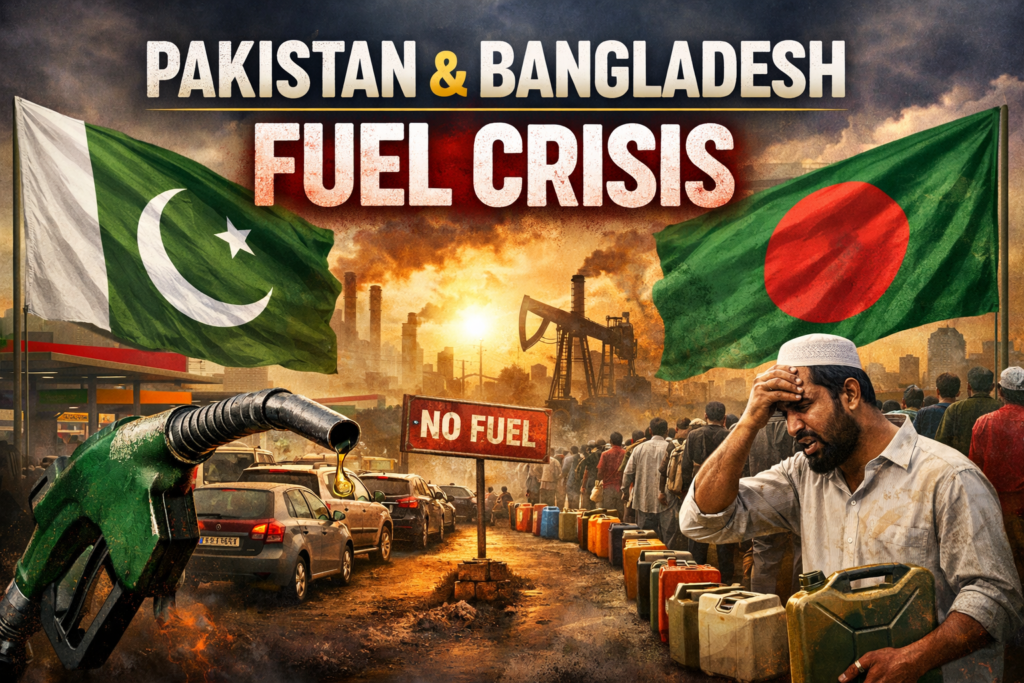
South Asia Under Siege: The 2026 Fuel Crisis Gripping Pakistan and Bangladesh.
The geopolitical landscape of March 2026 has shifted dramatically, leaving South Asia’s energy-dependent economies in a state of high alert. Following the escalation of the West Asia conflict and the subsequent blockade of the Strait of Hormuz—a chokepoint responsible for nearly 20% of the world’s oil flow—both Pakistan and Bangladesh are grappling with a dual-threat: skyrocketing prices and empty petrol pumps.
Pakistan: Record Prices and “Smart Lockdowns”.
In Pakistan, the crisis has moved from the headlines to the household budget with startling speed. The government recently approved a massive Rs 55 per liter hike for petrol and diesel to align with global market volatility.
- Sky-High Rates: Petrol is now being sold at a record-breaking Rs 321.17 per liter, while high-speed diesel has climbed to Rs 335.86 per liter. High-octane fuel has reportedly seen even more dramatic spikes, with some levies increasing by up to 200%.
- Austerity Measures: To curb demand, the federal government has implemented a four-day workweek for government offices and a 50% reduction in fuel allowances for ministers.
- Social Impact: In Sindh province, “smart lockdowns” have been enforced to restrict non-essential movement and gatherings. Major cities like Lahore and Karachi have reported queues lasting over 70 minutes as citizens scramble to fill tanks amid fears of a total dry-out.
Bangladesh: Rationing, Blackouts, and the 2-Litre Limit.
Bangladesh, which relies on imports for 95% of its energy needs, is facing equally dire straits. The Bangladesh Petroleum Corporation (BPC) has been forced to implement strict rationing to manage dwindling buffer stocks.
- Rationing Rules: At the height of the crisis, motorcycles were limited to just 2 liters of fuel per day, while private cars were capped at 10 liters. Although some restrictions were briefly lifted for the Eid-ul-Fitr holidays, many stations remain closed or undersupplied.
- The Power Gap: The fuel shortage has translated directly into a power crisis. Dhaka is currently experiencing five-hour rotational power cuts, and all universities have been shifted to online learning to reduce campus energy consumption.
- Economic Toll: Zero Carbon Analytics (ZCA) predicts that Bangladesh’s annual fossil fuel import bill will surge by $4.8 billion, a 40% increase over 2025 levels.
Industrial Fallout: Textiles and Agriculture.
The most concerning aspect of the crisis is its impact on the backbone of both nations’ economies: the textile industry.
- Textile Crisis: In Bangladesh, where textiles account for 85% of exports, mill owners warn that the sector is on the brink of collapse due to gas shortages. Similar warnings have been issued in Pakistan, where the sector makes up 65% of exports.
- Agricultural Disruption: Fuel shortages, particularly diesel, are disrupting agricultural supply chains. Four of Bangladesh’s five state-run fertiliser factories have been forced to halt operations as gas is diverted to keep power plants running.
Regional Contrast and the Way Forward.
While India has managed to maintain relative stability through strategic reserves (estimated at 60 days), its neighbors remain vulnerable. Pakistan is reportedly appealing to Saudi Arabia to reroute crude shipments via the Red Sea, an expensive but necessary detour to bypass the Hormuz blockade.
As the conflict in West Asia shows no signs of immediate resolution, both Islamabad and Dhaka are left with few choices: implement further austerity or secure massive international loans to fund spot-market imports.
In Pakistan, the crisis is defined by record-breaking numbers. With petrol hitting Rs 321 per litre, the government has enforced a four-day workweek and “smart lockdowns” to conserve dwindling stocks. From Karachi to Lahore, the surge in transport costs has sent food inflation skyrocketing, making basic survival a challenge for millions.
Meanwhile, Bangladesh is battling a severe power deficit. To manage a 95% dependency on energy imports, Dhaka has implemented five-hour daily blackouts and strict fuel rationing. With a two-liter limit for motorcyclists and the closure of state-run fertilizer factories, the industrial backbone of the nation is under immense strain.
About the Author






1 thought on “Hormuz Tension: Why Pakistan and Bangladesh are Facing an Unprecedented Fuel Crisis.”